
Oral Infection with African Swine Fever Virus: How Much Virus Is Needed to Cause Disease? New Research Reveals Infection Thresholds and New Perspectives for Farm Biosecurity
African Swine Fever (ASF) is a devastating haemorrhagic disease caused by African Swine Fever Virus (ASFV), and it continues to pose a serious threat to the global pig industry.
ASFV spreads through a variety of routes. In addition to direct contact and biological vectors such as soft ticks, indirect oral transmission via contaminated feed, drinking water and meat products is also considered an important pathway of virus spread. But how much virus does oral infection actually require? And how do different routes of exposure differ in efficiency? These questions bear directly on how precisely farm biosecurity measures can be designed, and on risk assessment.
A study recently published in the journal Pathogens evaluated the viral dose of genotype II ASFV required to establish infection in pigs by the oral route, giving us valuable experimental data and practical insights.
Today, Guanmu Precision Diagnostics walks through that study with you — breaking down its core findings and distilling the points that offer direct guidance for our day-to-day prevention and control work.
The study set out to determine the viral dose of the genotype II ASFV currently circulating in Europe (specifically the POL/2015/Podlaskie strain) that is required to establish infection by the oral route. The researchers randomly assigned 24 healthy 6-week-old pigs (Landrace × Large White crossbreds) to 4 groups of 6.
- Oral infection groups (3 groups): fed feed containing low (10³ TCID₅₀/0.5 mL), medium (10⁴ TCID₅₀/0.5 mL) and high (10⁵ TCID₅₀/0.5 mL) doses of ASFV, respectively.
- Nasal infection group (1 group): received a single low-dose (10³ TCID₅₀/2 mL) inoculation of the same ASFV strain via the nasal route.
Throughout the study, clinical signs and rectal temperature were monitored daily, and blood, nasal and oral swab samples were collected periodically. Viral DNA load was measured by qPCR, and ASFV antibodies in serum were tested at the end of the study.
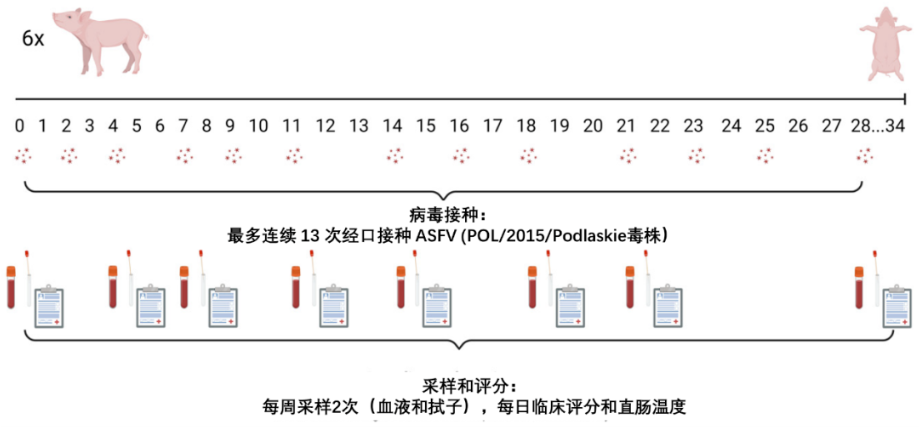
Experimental design for pigs (groups 1–3) fed ASFV orally in cake form.
The Nasal Route Is Highly Efficient: Even a Low Dose Causes Rapid Disease
The results showed that all 6 pigs in the nasal infection group (group 4) rapidly developed severe clinical signs after inoculation with the low dose of ASFV. From 4–5 days post-inoculation, the pigs developed high fever (temperature above 41 °C), and by days 6–7 they showed moderate to severe depression, respiratory distress and ataxia. Two of them were found dead on days 6 and 7.
Blood qPCR confirmed high-level viraemia (that is, large amounts of viral DNA in the blood) in these pigs. ASFV was also detected in the nasal and oral swabs of all 6 pigs, with viral loads in nasal swabs higher than in oral swabs.
This clearly shows that ASFV infection via the nasal (respiratory) route is highly efficient: even a relatively low viral dose is enough to trigger a rapid, severe course of disease. For pig farms, that means a high degree of vigilance is required against transmission through air, droplets or direct nose-to-nose/oral contact.
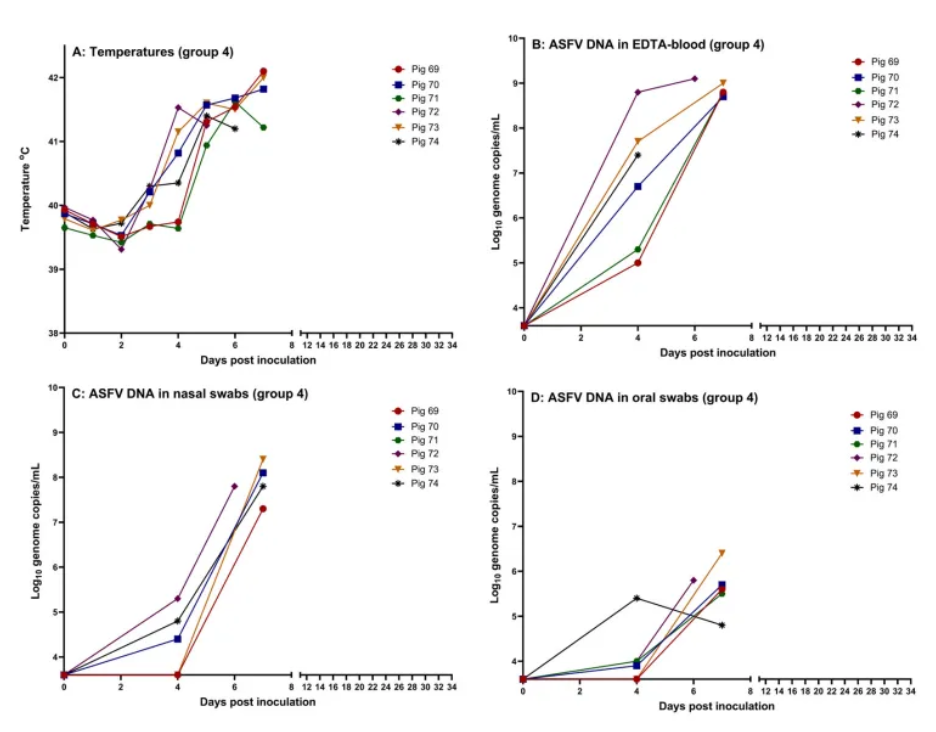
Data for the intranasally inoculated pigs (69–74). A: rectal temperature. B: ASFV level in blood. C: ASFV level in the nasal cavity. D: ASFV level in the oral cavity.
Oral Infection Is Markedly More Difficult: Only the High Dose Infected Some Pigs
In group 3, which was fed the high dose of virus, 3 pigs were eventually infected. Two of them (Nos. 63 and 64) developed high fever on day 4 or 5 after the first feeding, together with clinical signs such as depression, respiratory distress and reddened skin, and were humanely euthanised on day 7. Another pig (No. 66) began to run a fever on day 10 and was euthanised after clinical signs appeared the following day. High levels of ASFV were detected in the blood of all 3 infected pigs.
However, the other 3 pigs in the same group (Nos. 65, 67 and 68), despite receiving three high-dose oral feeds of virus, showed no clinical signs of ASFV infection at any point during the study (through to day 34), and no ASFV was detected in their blood.
More notably, in the two groups fed the medium and low doses (12 pigs in total), although the researchers carried out as many as 13 consecutive virus feeds, none of the pigs showed any sign of infection throughout the study.
All of this indicates that, in sharp contrast to nasal infection, establishing ASFV infection by the oral route is far more difficult.
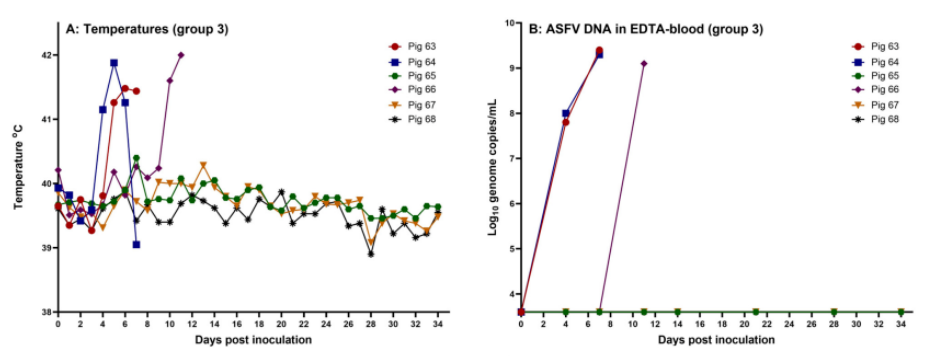
Rectal temperature and ASFV load in the blood of group 3 pigs. A: temperature. B: ASFV level in blood.
Virus Detected in the Oral Cavity of Uninfected Pen-Mates: The Importance of Contact Transmission and Environmental Decontamination
In the high-dose oral group (group 3), an interesting phenomenon emerged: the 3 uninfected pigs (Nos. 65, 67 and 68) penned together with the 3 pigs that ultimately became infected and showed clinical signs also tested positive for ASFV in their oral and nasal swabs. On day 7 in particular (by which time their pen-mates had already fallen ill and were shedding virus), the level of viral DNA in the oral swabs of these uninfected pigs was even higher than in their nasal swabs — the opposite of the pattern seen in the infected pigs, where nasal swab loads exceeded oral ones.
The researchers believe this indicates that the uninfected pigs took up virus shed by their infected pen-mates through oral contact. Although these pigs did not go on to develop systemic infection (they remained negative for virus in blood), the finding underlines that even when virus does not readily establish systemic infection by the oral route, live virus is still present in the environment — especially in areas contaminated by the saliva and secretions of infected pigs — and healthy pigs remain continuously exposed to the risk of infection.
This further highlights how important it is, when an outbreak occurs on a farm, to isolate sick pigs promptly and to thoroughly clean and disinfect the contaminated environment in order to control the spread of ASFV. The study also notes that ASFV transmission is not always highly efficient, particularly when no blood is present in the environment, which may explain why some of the pigs in the same pen were not infected.
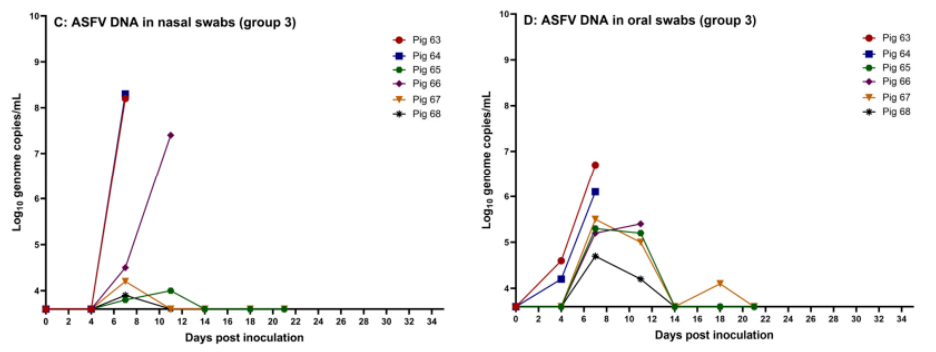
ASFV levels in the nasal and oral cavities of pigs fed the high dose of virus. C: nasal cavity. D: oral cavity.
Guanmu's Key Takeaways
Nasal inhalation is a far more efficient route of ASFV infection than the oral route: even a very low viral dose (10³ TCID₅₀ in this study) can cause rapid disease and death in pigs. Farms must therefore treat strict prevention of airborne transmission (for example through contaminated air and dust) and of direct nose-to-nose/oral contact between pigs (such as nuzzling and licking) as the top priority in biosecurity.
Oral infection with ASFV via feed or drinking water requires a relatively high viral load (in this study only the high-dose group, at around 10⁵ TCID₅₀, produced partial infection). This means that, while vigilance remains essential, occasional contamination at very low levels (such as a feed batch below the threshold) will not necessarily trigger a large-scale outbreak straight away. However, the type of contaminant (for example whether it contains blood or tissue, which can carry extremely high viral loads) and the duration and manner of contact between the virus and the pig's oral mucosa will significantly affect the actual risk of infection.
Even within the same pen, not every pig exposed to ASFV will immediately or inevitably become infected and fall ill, which points to individual variation among pigs and to the complexity of virus transmission. Yet virus may still be detected in the oral cavity of pigs showing no clinical signs, meaning they may become potential "hidden" sources of transmission or indicators of environmental contamination. Once a suspected or confirmed case appears on a farm, therefore, monitoring of the same and neighbouring groups (including environmental sampling such as oral swabs) and strict isolation, culling and environmental decontamination measures are essential.
Given the relatively high viral dose threshold for oral infection, strictly controlling the entry of any material that may carry high concentrations of ASFV into the farm is key to cutting the oral transmission chain. This includes: absolutely prohibiting the feeding of untreated food waste (swill) to pigs; rigorously reviewing the source and biosecurity status of purchased feed ingredients (especially animal-derived components); and strengthening the cleaning and disinfection of transport vehicles, personnel and other items entering the farm.